


Schaumburg Marketplace
Connecting Local Business
And Empowering Community
951 N Plum Grove Rd, Suite C
Schaumburg, IL 60173
◆ CONNECTING LOCAL BUSINESS · EMPOWERING COMMUNITY


Technology
From Mobile Phones to AI: Africa’s Digital Evolution and the Growing Opportunity for U.S. Businesses
How Africa’s transition from mobile connectivity to a data- and AI-driven economy is creating new opportunities for technology, investment, and business partnerships between Africa and the United States.
September 22, 2026 · 3 min read · By Parfait Ouezounvo
I'm a paragraph. I'm connected to your collection through a dataset. Click Preview to see my content. To update me, go to the Data Manager.
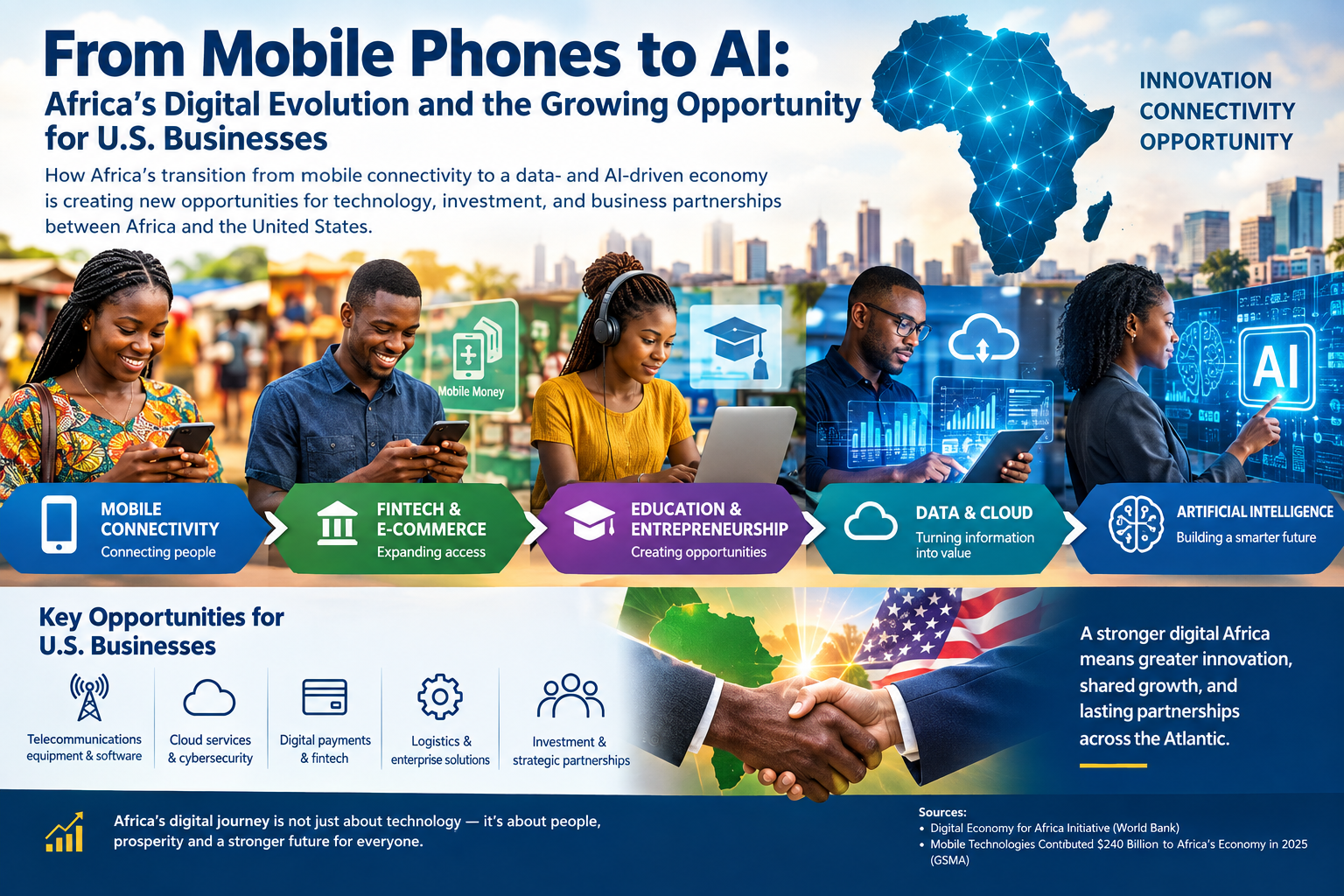
Africa's technology journey has transformed dramatically over the past two decades.
What began with mobile phones has evolved into a digital economy driven by connectivity and innovation.
Mobile technology opened new doors in banking, fintech, e-commerce, education, and entrepreneurship.
As digital adoption expanded, Africa also began generating an increasingly valuable resource: data.
Today, cloud computing, data analytics, automation, and artificial intelligence are shaping the continent's next technological chapter.
This evolution brings opportunities as well as challenges in infrastructure, skills, cybersecurity, affordability, and data governance.
At the same time, Africa's expanding digital markets are attracting growing interest from U.S. businesses and investors.
Retrospective: Where Did Africa's Digital Transformation Begin?
The journey accelerated with the expansion of mobile telecommunications, which allowed millions of Africans to connect without relying on traditional fixed-line infrastructure. Mobile phones quickly became tools not only for communication, but also for banking, mobile money, commerce, education, and entrepreneurship. This mobile revolution created the foundation for the digital economy that Africa is developing today.
Perspective: Where Does Africa's Technology and Data Ecosystem Stand Today?
Africa is moving beyond basic connectivity toward a digital economy powered by data, fintech, e-commerce, cloud services, and artificial intelligence. For example, a small business can now use mobile payments to serve customers, an online platform to reach new markets, and digital tools to track sales and understand customer behavior. In financial services, transaction data can help institutions identify fraud and develop services for customers who previously had limited access to traditional banking.
However, this progress is not without challenges. Many businesses still face limited access to reliable internet, affordable technology, digital skills, cybersecurity protection, and computing infrastructure. For example, a growing African e-commerce company may have strong customer demand but still face difficulties with reliable connectivity, secure digital payments, data storage, or delivery systems. Africa's opportunity today is therefore not only to increase digital adoption, but also to strengthen the infrastructure and skills needed to turn growing amounts of data into sustainable business value.
Retrospective: Where Did Africa's Digital Transformation Begin?
The journey accelerated with the expansion of mobile telecommunications, allowing millions of Africans to connect without relying on traditional fixed-line infrastructure. Mobile phones soon became more than communication devices: they became tools for banking, commerce, education, transportation, and entrepreneurship. The growth of mobile money is a powerful example. Services such as Kenya's M-Pesa demonstrated how mobile technology could provide financial services to people who had limited access to traditional banks, while creating new opportunities for consumers and small businesses. As smartphones and mobile internet expanded, digital platforms began connecting African businesses with increasingly larger domestic and international markets.
This early digital transformation also began creating opportunities for U.S. businesses. As African consumers and companies adopted mobile technology, demand grew for telecommunications equipment, software, cloud services, cybersecurity, digital payments, logistics technology, and other technology solutions. For example, a U.S. software company could provide technology to an African fintech platform, while an American cloud or cybersecurity provider could support businesses expanding their digital operations. The historical lesson is important: Africa's technology evolution did not simply create new consumers of technology; it created new markets, new entrepreneurs, and new opportunities for international partnerships. The mobile revolution therefore established the foundation for the broader data and AI economy emerging today.
Africa’s digital journey has moved from mobile connectivity to a growing data and AI economy. The next chapter will depend on stronger infrastructure, skills, innovation, and strategic partnerships. For U.S. businesses, Africa represents not only an emerging market but also an opportunity to build long-term partnerships with African companies, entrepreneurs, and technology leaders. The future of Africa’s digital transformation can create value on both sides of the Atlantic.
Sourcesworldbank.org all africa digital transformationprnewswire.com mobile technologies contributed 240 billion to africas economy…
More in Technology The shift from SaaS to AaaS (Agent-as-a-Service) is officially hereOct 5, 2026 Is your enterprise still treating AI Agents like a multi-million dollar, two-year IT roadmap?Sep 30, 2026 White House Creates AI Cybersecurity Coordination Effort to Speed Vulnerability ResponseSep 23, 2026
Share this articleFacebookXLinkedIn
Explore SchaumburgEvents →Things to Do →Coupons →Classifieds →Jobs →Videos →
SPONSORED

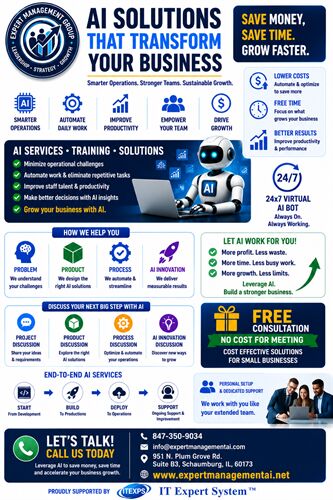
Expert Management Group INC
AI Services • AI Training • AI Solutions
Practical AI solutions built for business results. We help businesses improve efficiency, reduce manual work and grow with AI training, consultancy, staffing and cloud services. Automate smarter. Move faster. Grow with AI
Licensed
Paid placement. We don't endorse this business. Please verify licenses before hiring.
Keep reading
More local news and guides from Schaumburg Marketplace.